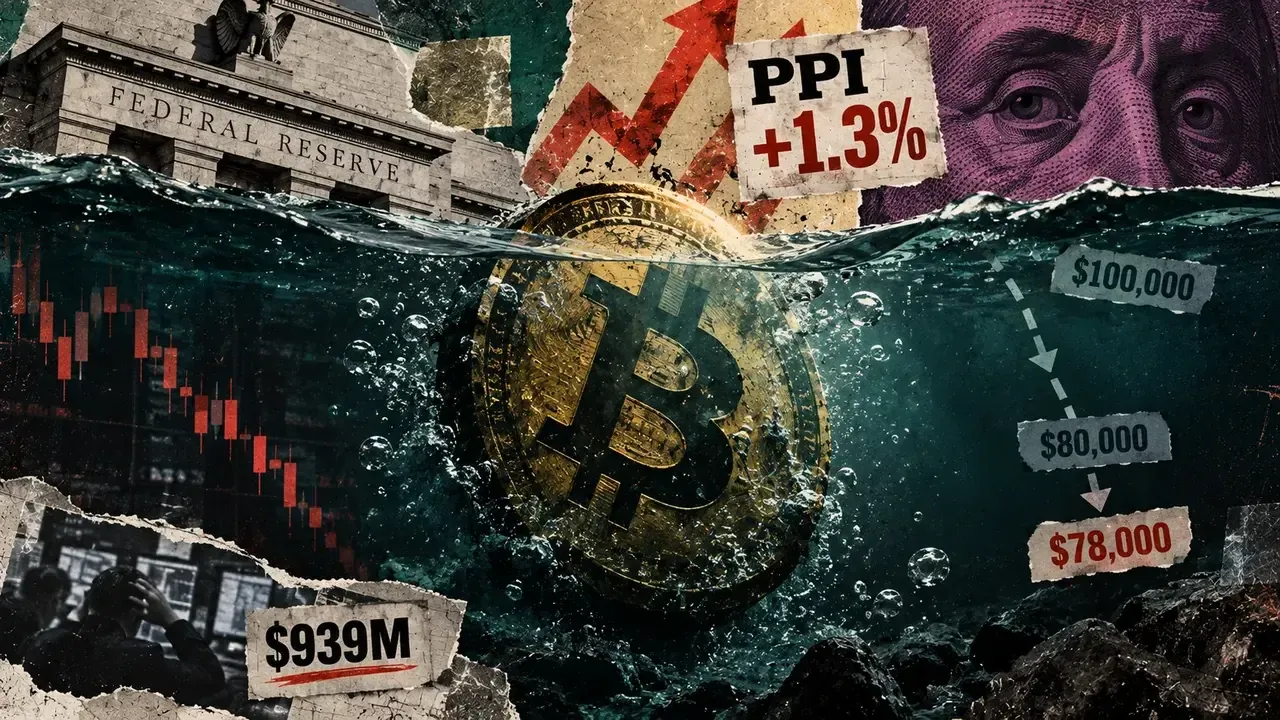
Bitcoin fell through $78,000 on Friday afternoon, giving up almost all of a weekly gain that had reached double digits, as investors read Federal Reserve Chair Kevin Warsh's first Jackson Hole address as a signal that the Fed is readier to raise rates than to cut them.
The selling ran across risk assets. Gold dropped 2.4% after climbing through most of August, and the S&P 500 and Nasdaq Composite gave up early gains to trade lower. Warsh set no path for the policy rate and named a condition the Fed has not met.
Bitcoin last traded at $77,955 on Coinbase, down 3% over 24 hours and up 0.7% over seven days, after reaching $81,479.50 at 9 p.m. ET Thursday and bottoming at $76,845.71 at 12:25 p.m. ET. Ether was at $2,442.56, down 3.2% on the day and up 1.6% on the week. Solana fell 3.1% to $105.57, holding a 15.3% weekly gain; XRP fell 4.5% to $1.4001 and is flat over seven days.
Warsh delivered the keynote, titled "In Our Time," at the Kansas City Fed's Jackson Hole symposium at 10 a.m. ET on Friday, his first as chair. "The Fed's preferred measure of inflation, the 12-month change in the PCE price index, stands at 3.7 percent, while the six-month change is 4.1 percent," he said, according to the text published by the Federal Reserve Board. "The comparable measures from the consumer price index (CPI) are also elevated, as are the core measures of both PCE and CPI inflation. None of these measures are perfect, but they all tell a similar story: Inflation is running above our 2 percent target. So the Fed's predominant focus right now should be on prices."
He offered a test: "We must be confident that underlying inflation is moving to our objective, clearly and at sufficient speed. Otherwise, we have work to do." The speech also restated his objection to signalling decisions in advance. "I have set out to change the form and function of the Fed Chairman's so-called forward guidance," Warsh said. "You might know about my long-time discomfort with early pronouncements of future policy decisions." Among his numbered principles was a focus on money supply: "Sixth, money matters. It's not fashionable these days, but my view is that money has something important to do with monetary policy. We should pay attention to money created by the central bank and money that comes from the banking and financial systems."
The symposium's theme this year is "Financial Innovation: Implications for Payments and Policy." Warsh's remarks made no mention of stablecoins, tokenization or digital assets.